Fast shipping from Sweden Member of EU
 0
0







Top brands

































A good sharpening steel is one of the easiest ways to keep your knives in tip-top shape. Instead of grinding away steel, it straightens out the edges that have been bent during use - something that happens every time you cut into something hard, whether it's meat, wood or plastic. In this guide to the best sharpening steels in the test, we'll go over how they work, what sets different models apart and which ones are best for kitchen knives, hunting knives and outdoor blades.
Whether you use your knife daily or just occasionally, a sharpening steel will extend the life of your knife and reduce the need for sharpening. It's easy to use, takes minimal time and gives immediate results. Below you'll find the sharpening steels that perform best, plus advice on what to consider depending on the material and application.
Which sharpening steel is best for you depends on what knives you use and how much work you want to put in. A simple steel will do a good job in the kitchen, while outdoor knives and hunting knives often benefit from a diamond or ceramic steel. No matter what your purpose is, there are several really good options to choose from.
In this list, we highlight six sharpening steels from manufacturers such as Fällkniven, Lansky and Morakniv - all well-known for their quality and performance. Here you will find both classic steels for everyday use and more advanced variants with diamond or ceramic coatings that also work on harder knife steels. Perfect for those who want to keep their edge in top condition without having to resharpen all the time.
This sharpening steel from Fällkniven is no ordinary steel - the entire surface is covered with industrial diamonds from DeBeers, which provides an extremely long-lasting grinding effect. The core itself consists of a well-hardened premium steel that provides real stability when used, regardless of the type of knife.
D12Pro has been tested by independent institutes in the UK, and the results clearly show why it stands out: after over 40,000 strokes, it still works just as well - while other steels in the test gave up after just 4,000. This is a sharpening steel you can rely on for many years, even with frequent use.
Specifications:

Fällkniven D12 is an oval sharpening steel that is designed to quickly sharpen kitchen knives - even those with hard, stainless steel. Thanks to the fine diamond coating, you can regain sharpness in just a few strokes, making it perfect for those who want to keep up the pace in the kitchen without compromising on the result.
The steel is also surface-treated with titanium-aluminum-nitride - an extremely hard material used on exclusive products to provide long durability. D12 effectively recreates the wedge shape of the edge, and the micro-serration that occurs can even improve the cut in certain raw materials, such as fresh bread.
Specifications:
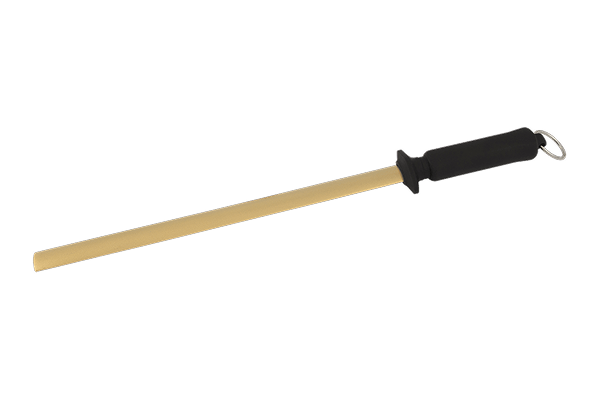
Lansky's Sharp Stick in diamond version is a classic butcher-style sharpening steel, equipped with a fine-grained diamond surface (400 grit) that quickly restores sharpness to both kitchen knives and cutting blades. This model combines fast action with a secure grip - perfect for those who want precision without the hassle of a sharpening system.
The handle is covered in non-slip rubber and has a guard bar that protects your fingers during use. It only takes a few strokes to restore a sharp edge, even on knives that have been used hard. The sharpening steel is also easy to clean - just water and a cloth are needed.
Specifications:

Fällkniven C10 is a ceramic sharpening steel that has been specially developed for high-quality kitchen knives. With a grinding surface of 270 mm, it delivers an extremely sharp edge, while being significantly more durable than traditional ceramic bars. The surface has a hardness of 9 on the Mohs scale - almost as hard as diamond.
What makes C10 unique is its shock-absorbing properties. Where many ceramic steels crack when dropped, C10 can withstand a blow from kitchen table height without breaking. This makes it a really practical choice in everyday life, especially if you work quickly and are not always careful with your equipment.
Specifications:
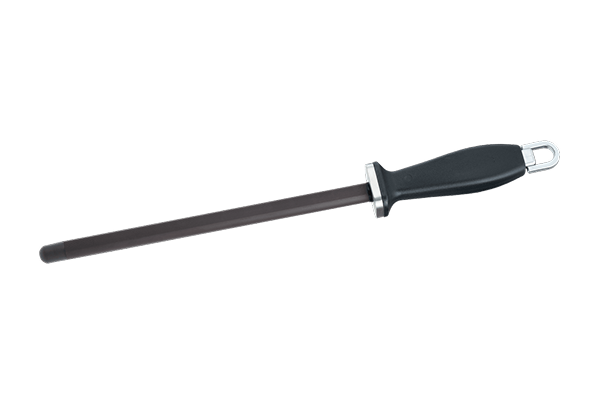
This is Lansky's classic butcher-style sharpening steel - simple, effective and built for everyday use. Unlike diamond or ceramic versions, it does not remove any material but rather straightens the edge with each stroke. Perfect for those who want to maintain sharpness without grinding down their knife.
The Sharp Stick has a 229 mm steel surface and is equipped with a non-slip rubber handle and a guard for safe handling. It only takes a few strokes to get that sharp feeling back - especially on knives that are already well-maintained.
Specifications:

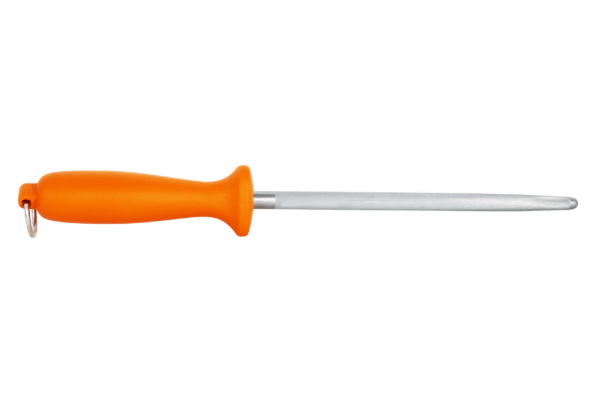
Morakniv's Hunting Sharpening Steel is a practical tool for those who want to keep their hunting knife in top shape. This sharpening steel is not for grinding away material - but for straightening the edge back to the correct position and extending the life of the knife. For maintenance in the field or when slaughtering.
The handle is made of polymer with a friction grip and a sturdy finger guard, which provides both safety and control even when it is wet, cold or stressful. The color scheme is hunting-inspired and makes it easy to see among the equipment.
Specifications:
A sharpening steel is used to straighten the edge of a knife - not to grind away material in large quantities. When you cut a lot, especially in hard or fibrous materials, the edge bends microscopically. The knife feels dull, but in many cases it is not really dull - it just needs to be straightened. And that is where the sharpening steel comes in.
Classic sharpening steels made of hardened steel do not remove any steel at all. They act as a comb for the edge and restore its shape quickly and easily. Diamond and ceramic sharpening steels, on the other hand, have such hard surfaces that they sharpen easily while straightening the edge. This makes them effective on knives made of harder steel, but they still do not remove as much material as a whetstone or whetstone.
It is important to keep these separate:
A sharpening steel is therefore a maintenance tool, while a whetstone and sharpening stone are for restoration.
Use a sharpening steel before the knife becomes noticeably dull. A couple of strokes before or after each use are often enough. If you wait until the knife feels dull and requires force - then it is too late for a sharpening steel, and you need to move on to a whetstone or sharpening stone.
With regular maintenance, you will keep your knife sharper longer and avoid unnecessary wear. A sharpening steel is simply your first line of defense against dull knives.
There are several different types of sharpening steels, and which one is best for you depends on the type of knife you use and how you want to maintain the edge. All sharpening steels have the same basic purpose - to straighten the edge - but they differ in material, grinding effect and how much they affect the sharpness of the knife.
The classic sharpening steel is often made of hardened steel without a coating. It straightens the edge without grinding away material, which is gentle on the knife. This is a favorite in many kitchens and is especially suitable for chef's knives that are used frequently but have not become really dull yet.
Advantages:
A sharpening steel with a diamond coating has more grinding effect than a regular steel. It removes some material from the edge and is therefore suitable when the knife has started to feel really dull. It also works on harder steels where a classic steel won't bite.
Advantages:
Ceramic sharpening steels have a very fine grinding effect and are often used on Japanese or thin knives where precision is extra important. They sharpen easily while straightening the edge. Many ceramic steels are also very hard - but can become fragile.
Advantages:
|
|
|
|