Choose the right fly fishing gear
When choosing fly fishing gear, it is important to consider where you will be fishing and what fish you are targeting. A lighter rod is often better suited to smaller waters, put and take fishing or when fishing for smaller fish. For larger waters, longer casts or more powerful fish, a stronger rod and heavier line may be a better choice. The equipment simply needs to match both the environment and the fishing method.
For those who are new to fly fishing, a complete fly fishing set can be a smart first step. Then the rod, reel and line are already adapted to work together, which makes it easier to focus on the basics of casting technique. As you become more experienced, you can supplement with more lines, different pegs and a wider selection of flies to better adapt your fishing to the situation.
The fly line is one of the most important pieces of equipment because it affects cast distance, presentation and control. A float line is often a good all-round choice and works in many situations, while sinking lines or intermediate lines can be useful when the fish are deeper. The tip also plays a big role, as it helps the fly to present itself naturally on the surface of the water or below the surface.
Fly choice is often guided by what the fish is eating at the moment. Dry flies are used when the fish are taking insects on the surface, nymphs are fished below the surface and streamers imitate small fish or other prey. Having several types of flies in the box makes it easier to adapt when conditions change. It is precisely this variety that makes fly fishing so exciting and technically interesting.
Fly fishing in lakes, rivers and flowing water
Fly fishing can be done in many different environments, and each type of water has its own requirements for equipment and technique. In smaller lakes and put and take waters, it is often about casting in a controlled manner, finding the right depth and varying the retrieve. Here, lighter equipment and classic fly patterns often work very well.
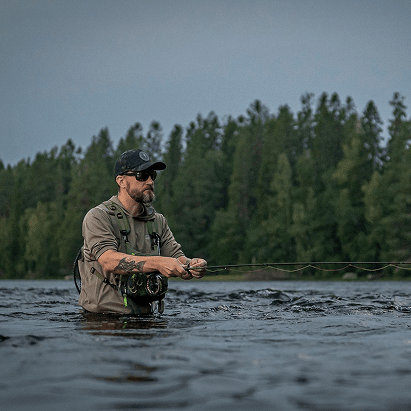
In flowing water, you need to think more about how the fly drifts with the current. A natural drift can be crucial for the fish to take the fly. Here, casting angle, line handling and stick length become particularly important. Wading and positioning also play a big role, as you often need to position yourself correctly to be able to present the fly in a natural way.
In larger rivers, longer casts, heavier lines and stronger rods can be an advantage. Here, two-handed rods or more specialized equipment may be relevant depending on the fishing. For those who want to develop in fly fishing, it is therefore wise to choose equipment that suits the most common fishing, but which also gives the opportunity to grow with the technique over time.
Fly fishing for beginners and experienced fishermen
Fly fishing can seem technical at first, but with the right equipment and a little practice, you can quickly get started. The most important thing is to start simple and learn the basics of casting, how the line behaves and how the fly is presented. A balanced fly fishing set makes the start much easier because the equipment is already adapted to work together.
For more experienced anglers, the choice is often about fine-tuning your equipment to suit your fishing style. This may mean choosing a rod with a specific action, a line that suits specific casting techniques, or flies that are adapted to local conditions. The more you learn about the water, the fish, and the insect life, the more you can adapt your fishing and increase your chances of successful trips.
Regardless of your level, fly fishing is a method that can always be developed. There are always new techniques to try, new waters to explore, and new situations to adapt to. With the right equipment, you will be better equipped to enjoy fishing, whether your goal is relaxation, technique training, or landing the next great fish.
FAQ – Frequently Asked Questions about Fly Fishing
What do you need to get started with fly fishing?
To get started with fly fishing, you usually need a fly rod, fly reel, fly line, jig and flies. It may also be a good idea to have a fly box, jigging material, bait, wading equipment and other accessories depending on where you are going to fish. For beginners, a complete fly fishing kit is often an easy and safe choice.
Is fly fishing hard to learn?
Fly fishing requires some practice, especially when it comes to casting technique and line handling. However, it is possible to get started with basic casting fairly quickly if the equipment is properly balanced. With practice, it becomes easier to cast further, present the fly better and adapt fishing to different situations.
What equipment is best for beginners?
For beginners, a complete fly fishing set in an all-round class is often suitable. There, you get a rod, reel and line that are adapted to each other, which makes it easier to learn the basics. An all-round set works well in many waters and provides a stable start before you possibly move on to more specialized equipment.
Can you fly fish in both lakes? and flowing water?
Yes, fly fishing works in both seas, rivers, lakes and flowing water. However, equipment, fly selection and technique may need to be adapted to the environment. In seas, longer casts and varied retrieves are often used, while flowing water requires more focus on drift, casting angle and line handling.
What is the difference between fly fishing and spinning fishing?
The biggest difference is how the cast works. In spinning fishing, it is the weight of the line that moves the line forward, while fly fishing is based on that the weight of the fly line drives the cast. This means that the technique, equipment and presentation of the bait differ greatly between the methods.
What fish can you catch with fly fishing?
Fly fishing is often used for species such as trout, rainbow trout, grayling and salmon, but the method can also be used for other fish species depending on the equipment and fly choice. By adjusting the rod class, jig and fly type, fly fishing can be used in many different types of water.
Which fly line should I choose?
A float line is often the best choice for beginners and all-round fishing because it is easy to handle and works in many situations. For fishing deeper in the water, intermediate or sinking lines may be better. The choice depends on where the fish are and how you want to present the fly.

 Member of EU
 0
0